
Best Things to Do in Tbilisi: A First-Timer's Guide
The Best Things to Do in Tbilisi: A First-Timer's Guide to Georgia's Capital
Most travellers arrive in Tbilisi with a list of three or four sights and leave wishing they had given the city a week. There are more interesting things to do in Tbilisi than almost any capital its size, and the reason is geography as much as history: this is a city that sits on a fault line between worlds, where Persian bathhouses, Orthodox cathedrals, Soviet apartment blocks and glass footbridges all crowd into the same river valley. Walk for ten minutes here and you cross several centuries. For anyone planning a first trip to Georgia, the capital is both the obvious starting point and a destination that rewards far more attention than the standard layover allows.
What makes Tbilisi so compelling is the way the old and the new refuse to settle into separate quarters. You can soak in a sulphur bath that drew Pushkin two centuries ago, then climb a hill to a futuristic concert hall that still divides local opinion. You can eat dumplings in a courtyard restaurant where the recipe has not changed in generations, then drink natural wine in a bar that opened last spring. This guide walks you through the sights that genuinely earn their place, the neighbourhoods worth wandering without a plan, the day trips that justify an early start and the practical details that make a visit run smoothly. By the end you should have enough to sketch out your own days in the city rather than simply ticking off a checklist.
Why Tbilisi Deserves More Than a Quick Stopover

Tbilisi grew up in a narrow valley carved by the Mtkvari river, with wooded hills rising on either side and the Greater Caucasus looming somewhere beyond. That setting shaped the city's character. Defensible, watered by hot springs and positioned on the trade routes between Europe and Asia, it became a prize fought over by Persians, Arabs, Mongols, Ottomans and Russians, each of whom left a mark on its streets. The result is an architectural patchwork found almost nowhere else: carved wooden balconies leaning over cobbled lanes, brick bath domes, an Armenian quarter, a former German colony and the occasional minaret, all within walking distance of one another. Understanding this layered past is the key to enjoying the city, because in Tbilisi the buildings really do tell the story.
The cultural pull is just as strong. Georgia treats hospitality as something close to a sacred duty, expressed most vividly at the supra, the traditional feast led by a tamada or toastmaster who steers the table through a sequence of heartfelt toasts. Wine is woven through all of it, which is fitting given that Georgia is widely regarded as the birthplace of winemaking. Set against the country's other headline experiences, from the cliffside churches of Kazbegi to the cave city of Vardzia and the wine cellars of Kakheti, a few days in Tbilisi might sound like the least dramatic part of a trip. In practice it is often the part people remember most fondly, precisely because it is lived in rather than staged. The city is also remarkably affordable, which means you can eat and drink well without watching every lari.
"Georgia is the cradle of wine."— Hugh Johnson, Vintage: The Story of Wine
There is a practical argument too. Tbilisi is the hub from which the rest of Georgia unfolds. The main airport sits just outside the city, the country's road and rail networks radiate from here and almost every great day trip, whether to the mountains, the wine country or the ancient capital of Mtskheta, begins and ends in the capital. Treating Tbilisi as a base rather than a transit point lets you settle into a rhythm, find a favourite café and use the city as a comfortable launchpad for the wilder corners of the Caucasus.
A City Built on Warm Water
Tbilisi owes its existence to a hot spring and, according to legend, a falcon. The fifth-century king Vakhtang Gorgasali is said to have been hunting in the forested valley when his bird brought down a pheasant, and both tumbled into a steaming sulphur pool. Struck by the warm waters, the king founded a city on the spot and moved his capital here from nearby Mtskheta. The name itself comes from the old Georgian word tbili, meaning warm, and those same springs still rise beneath the Abanotubani bath district today. Whether or not the falcon ever existed, the story captures something true about the place: Tbilisi has always been a city that people chose to settle in for its comforts as much as its defences.
The historic core is larger and looser than the tidy old towns of western Europe, spreading across both banks of the Mtkvari. On the right bank, the district known as Kala tumbles down the slope beneath Narikala Fortress, while neighbouring Sololaki is a showcase of grand nineteenth-century facades and faded Art Nouveau entrance halls. Across the water lie Avlabari, long the heart of the Armenian community, and Chugureti, first laid out by German settlers and now the city's most creative quarter. Each of these areas has its own texture, and the pleasure of Tbilisi lies in drifting between them on foot, peering into courtyards and following the smell of fresh bread.
The city has changed enormously in the past two decades, and the pace shows no sign of slowing. Restored mansions sit beside crumbling ones still waiting their turn, sleek towers rise on the skyline and a generation of young Georgians has filled the older neighbourhoods with wine bars, galleries and design studios. Some of this renewal is polished and some is rough around the edges, but the energy is real. For visitors this means a city that feels alive rather than preserved, where the next interesting thing is often just an unmarked doorway away.
The Best Things to Do in Tbilisi
Old Town and Narikala Fortress
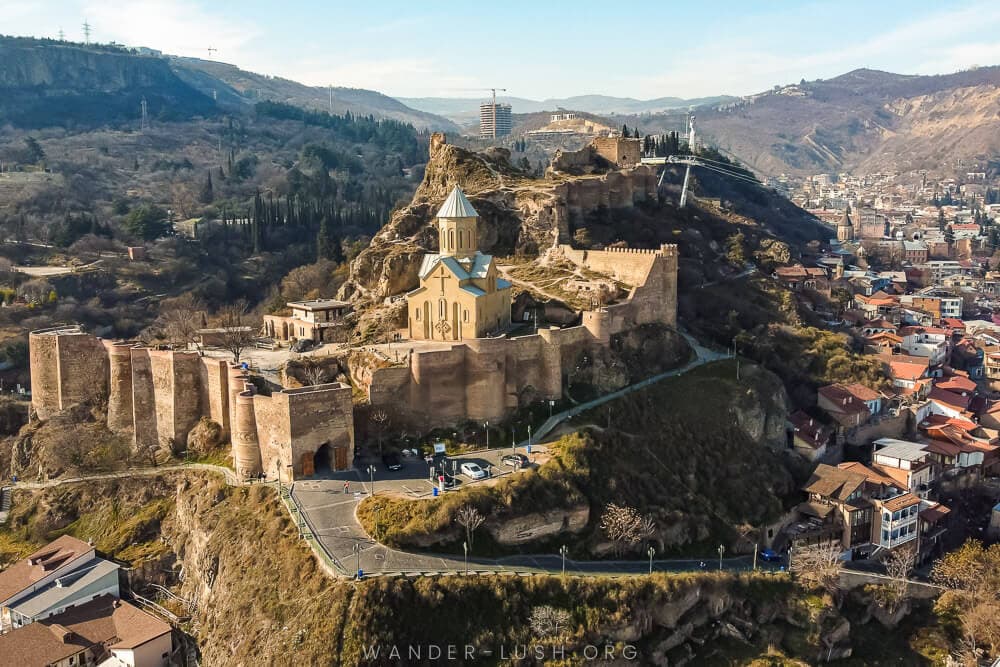
Begin where the city began, in the tangle of lanes below Narikala Fortress. The citadel has guarded the valley since the fourth century, growing under successive rulers before much of it was wrecked by an explosion in 1827, and its silhouette remains the defining image of Tbilisi. The walls are free to wander and the views over the rooftops, church domes and river are the finest in the city. The easiest way up is the cable car that glides from Rike Park across the river, a short ride that doubles as a sightseeing trip in its own right. Below the fortress, the streets of Kala and Sololaki reward slow exploration, with the little St George's church, the Juma Mosque and the reconstructed Meidan Bazaar all within a few minutes' walk.
At the time of writing the interior of Narikala Fortress is closed for restoration work, so sections may be fenced off. The walls, the cable car and the panoramic views remain open and well worth the trip, but check the current situation locally before planning your visit, as access changes from season to season.
The Sulphur Baths of Abanotubani
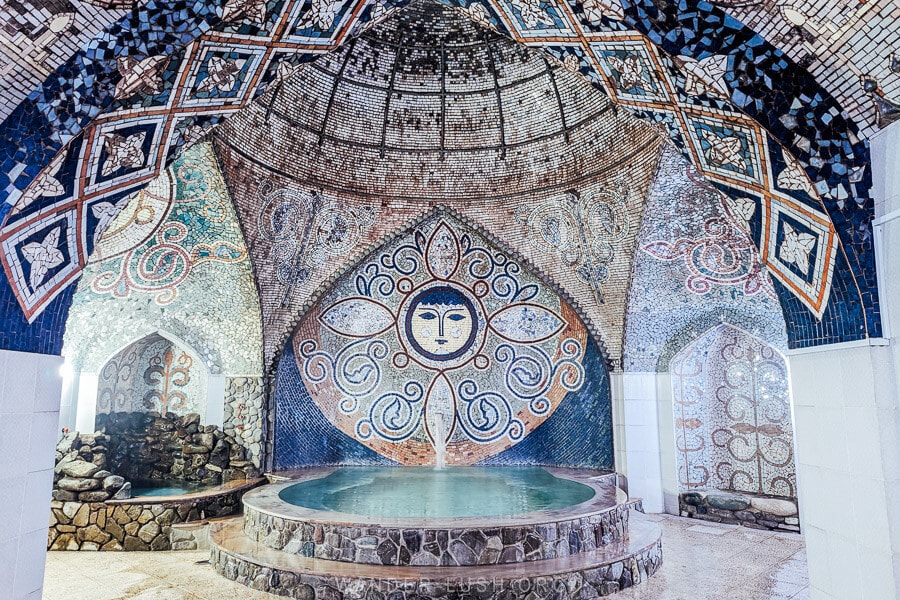
No experience captures Tbilisi quite like an hour in the sulphur baths. Cluster of low brick domes at the foot of Narikala, the Abanotubani district taps the same warm springs that gave the city its name, and bathing here has been a social ritual for centuries. The most photographed building is the blue-tiled Orbeliani bathhouse, its mosaic facade inspired by Persian design, though the experience itself happens in the steamy chambers below ground. For a few dozen lari you can book a private room and add a kisi, the brisk full-body scrub administered by an attendant that leaves you feeling thoroughly renewed. The naturally heated, mineral-rich water is said to ease aches and stiffness, and a visit is as much about cultural immersion as relaxation.
"I have never encountered anything more luxurious than the Tiflis baths."— Alexander Pushkin, A Journey to Arzrum
Go on a weekday morning for the calmest experience, since weekend evenings book out fast and rooms can be hard to come by. Bring flip-flops for the warm wet floors, and remember that the private rooms are worth the modest extra cost over the basic public baths. Booking a day ahead is wise, particularly at the better-kept houses.
Sameba, Metekhi and the City's Churches
Tbilisi is a deeply Orthodox city, and its churches range from the monumental to the intimate. Dominating the eastern skyline is Sameba, the Holy Trinity Cathedral, a vast gold-domed structure completed in 2004 and now among the largest Orthodox churches anywhere. Older and far smaller, the Metekhi church stands on a rocky bluff above the river on the spot where King Vakhtang Gorgasali is said to have built his palace, and his equestrian statue keeps watch outside. In the Old Town you will also find Sioni Cathedral, long the seat of the Georgian church, and the sixth-century Anchiskhati basilica, the oldest surviving church in the city. Visiting these places offers a window into a faith that has shaped Georgian identity for more than 1,500 years, and a moment of quiet between the busier sights. Dress modestly, since women are expected to cover their heads and shoulders and men should remove hats.
Rike Park, the Bridge of Peace and the Cable Car
The left bank around Rike Park is where Tbilisi shows off its modern face. The Bridge of Peace, a sinuous glass-and-steel footbridge designed by the Italian architect Michele De Lucchi, arcs across the Mtkvari to link the Old Town with the park, glowing with thousands of LEDs after dark. Opinions on the bridge and the curving glass tubes of the unfinished concert hall beside it are firmly divided among locals, which is part of the fun. From Rike the cable car carries you up to Narikala in a couple of minutes, making this the natural pivot point of a day's sightseeing. The park itself is pleasant for a stroll, with fountains, lawns and a giant chessboard, and the riverside setting is at its best in the early evening.
Mtatsminda and the View From Above
For the broadest view of the city, ride the funicular up Mount Mtatsminda, the wooded hill that rises behind the centre. The railway has been hauling passengers up the slope since 1905 and ends at a hilltop park with an old-fashioned big wheel, restaurants and sweeping panoramas across the valley. Partway up sits one of the city's more reflective corners, the Mtatsminda Pantheon beside the church of Mamadaviti, where many of Georgia's most celebrated writers and public figures are buried, among them the Russian playwright Alexander Griboyedov and his young Georgian wife Nino Chavchavadze. Come toward sunset, when the light softens and the whole city spreads out beneath you. The funicular requires its own travel card, sold at the lower station.
Rustaveli Avenue and the Markets
Tbilisi's grand boulevard, Rustaveli Avenue, is named after the medieval poet Shota Rustaveli and lined with the institutions of the modern nation: the parliament building, the opera house, the national gallery and the Georgian National Museum, whose archaeology and Soviet-occupation exhibits are genuinely worth an hour or two. For a very different kind of browsing, head to the Dry Bridge Market, an open-air flea market where vendors lay out Soviet badges, old cameras, hand-painted ceramics and the occasional family heirloom. Across the river in Chugureti, the former Soviet sewing factory now known as Fabrika has become the centre of the city's creative scene, its courtyard ringed with bars, studios and casual eateries. Wandering between these spaces gives a clear sense of how Tbilisi balances its imperial past with its restless present.
See the best of the capital in a day — Mtatsminda, Sameba Cathedral, the Chronicles of Georgia and the Old Town, with a guide who knows its stories.
Explore the Tbilisi City Tour →Eating and Drinking in Tbilisi
You cannot understand Tbilisi without eating your way through it. Georgian food is one of the great underrated cuisines, built around cheese, walnuts, fresh herbs and slow-cooked meats. The two dishes every visitor should try are khachapuri, a boat or disc of bread filled with molten cheese, and khinkali, the pleated soup dumplings you grip by the topknot and eat by hand. Beyond these staples, look for badrijani, aubergine rolls stuffed with a garlicky walnut paste, hearty bean stews and skewers of charcoal-grilled mtsvadi. To drink, there is qvevri wine made in buried clay vessels and chacha, the fiery grape spirit best taken in a single gulp. The city's wine bars, many of them clustered in the Old Town and Vera, are an ideal place to taste amber wines and bold Saperavi reds before heading out to the vineyards of Kakheti.
Day Trips From Tbilisi
The capital's greatest practical advantage is how easily it opens onto the rest of the country. The closest and most rewarding escape is Mtskheta, Georgia's ancient capital and spiritual heart, barely half an hour away. Here the eleventh-century Svetitskhoveli Cathedral and the hilltop Jvari Monastery, both UNESCO-listed, mark the spot where Georgia adopted Christianity in the fourth century. A morning in Mtskheta pairs neatly with a visit to a nearby winery, and many travellers consider it the single best half-day trip from the city.
For mountain scenery, the long drive north along the Georgian Military Highway leads to Kazbegi, properly called Stepantsminda, where the lonely Gergeti Trinity Church stands against the snow-capped bulk of Mount Kazbek. The route passes the lakeside Ananuri fortress and the ski resort of Gudauri, and while it can be done in a day it is a full one, so an early start and a reliable driver make all the difference. East of the city lies Kakheti, Georgia's main wine region, where the walled town of Sighnaghi and a string of family cellars reward a day or an overnight stay. Further options include the cave town of Uplistsikhe near Gori, with its rooms hewn from the rock, and the remote desert monastery of David Gareja on the border with Azerbaijan, though access there can be sensitive and is best arranged through a guide. Each of these trips shows a different face of Georgia, and together they explain why so many visitors base themselves in Tbilisi and venture out from there.
Practical Travel Information

The most comfortable times to visit are late spring, from roughly late April through June, and early autumn in September and October, when the days are warm, the light is soft and the surrounding hills are green or turning gold. Summer can be hot, with temperatures often pushing into the mid-thirties Celsius, though the city stays lively and many escape the heat on day trips into the mountains. Winter is cold and occasionally snowy, quieter and atmospheric, and it pairs well with the nearby ski slopes of Gudauri. Whatever the season, pack layers and comfortable shoes with grip, because the cobbled lanes and steep hills of the Old Town punish flimsy footwear.
Getting around is straightforward and cheap. The centre is best explored on foot, and beyond it a clean two-line metro and an extensive bus network cover the city for around a lari a ride, paid with a rechargeable MetroMoney card or a contactless bank card. The Bolt ride-hailing app is the easiest way to cross town and rarely costs more than a few euros, which spares you haggling with the taxi drivers who congregate at the airport and major sights. For day trips, shared marshrutka minibuses depart from stations such as Didube, though groups and anyone short on time usually prefer a private driver or a guided tour. Driving yourself is possible but not relaxing, as local traffic is assertive, parking is tight and Georgia enforces a strict zero-tolerance policy on drink-driving.
A few cultural habits are worth knowing. Georgians are famously hospitable, and an invitation to eat or drink is meant sincerely, so accept graciously and pace yourself, especially if toasts start flowing. In churches, modest dress is expected and women generally cover their heads, with scarves often available at the door. Tipping around ten per cent is appreciated in restaurants but not compulsory. On the practical side, Tbilisi is one of Europe's most affordable capitals, with mid-range hotel rooms widely available and meals costing a fraction of western European prices, so a modest daily budget stretches a long way. The city is also very safe, with low levels of crime, although you should watch the traffic and the uneven pavements rather than worry about anything more sinister.
Connectivity is excellent. Local SIM cards from providers like Magti and Silknet are cheap and quick to set up, mobile data is fast across the city and free wi-fi is common in cafés, hotels and many public spaces. Accommodation ranges from sociable hostels and family guesthouses to boutique hotels in restored mansions and international chains, with the Old Town, Sololaki and Vera among the most appealing areas to stay. One honest caveat concerns accessibility: Tbilisi's hills, cobblestones, steps and patchy pavements make it challenging for travellers with limited mobility, so it is worth choosing central accommodation and flagging any specific needs when you book.
Ready to venture beyond the city? Start with Mtskheta — Jvari Monastery, Svetitskhoveli Cathedral and the cable car — an easy half-day from Tbilisi with a local guide.
Explore the Mtskheta Day Trip →Why Choose GeoWonder
Tbilisi rewards travellers who have someone to translate not just the language but the layers of history and custom behind what they are seeing. Our guides are local, and they know the difference between the bathhouse worth your money and the one that overcharges, the courtyard restaurant where the khinkali are made fresh and the unmarked wine bar that never appears on the usual lists. That kind of knowledge turns a list of sights into a coherent, enjoyable few days.
We keep groups small and itineraries flexible, whether you want a relaxed walking introduction to the Old Town, a private day trip to Kazbegi or Mtskheta or a longer journey that links the capital with the wine country and the mountains. Comfortable transport means no one has to choose between tasting Georgian wine and driving safely afterwards, and our focus stays on genuine experiences rather than rushed, packaged stops. The aim is simple: to help you see and understand Tbilisi and the wider Caucasus the way Georgians do.
Conclusion
The best things to do in Tbilisi are not isolated attractions to be photographed and forgotten but threads in a single, layered city that has been welcoming travellers for fifteen centuries. Soak in the sulphur baths, climb to Narikala for the view, lose an afternoon in the lanes of the Old Town and let a long Georgian supra teach you why hospitality here is treated as an art. Use the capital as your base, venture out to Mtskheta and the mountains and you will leave understanding why so many visitors arrive for a couple of nights and start plotting how to return. Tbilisi is a city that opens up the more time you give it, and the Caucasus beyond it is waiting whenever you are ready to explore further.
How many days do you need in Tbilisi?
Two to three full days are enough to cover the essentials, including the Old Town, Narikala Fortress, the sulphur baths, Rustaveli Avenue and the main churches, with time left for the city's excellent food and wine. If you want to add day trips to Mtskheta, Kazbegi or the Kakheti wine region, plan for four to five days based in the capital. Tbilisi genuinely rewards a slower pace, so travellers with a week can settle into a neighbourhood, return to favourite cafés and explore lesser-known corners like Chugureti and Mtatsminda. For most first-time visitors, three or four days strikes the right balance between depth and momentum.
Is Tbilisi safe for tourists?
Yes, Tbilisi is considered one of the safer capitals in the region, with low rates of violent crime and a generally welcoming attitude toward visitors. The most common hazards are practical rather than criminal: fast and assertive traffic, uneven pavements, steep cobbled streets and the occasional stray dog, most of which are tagged and harmless. Standard precautions apply, such as keeping an eye on belongings in crowded markets and agreeing fares or using the Bolt app rather than unmetered taxis. Solo travellers, including women, generally report feeling comfortable, though as anywhere it pays to stay aware late at night. Overall, safety is rarely a serious concern for visitors to the city.
What is the best time of year to visit Tbilisi?
Late spring and early autumn are ideal, with warm and settled weather that suits long days of walking and sightseeing. April to June brings green hills and mild temperatures, while September and October offer golden light and coincide with the grape harvest in the surrounding wine regions. Summer, from July to August, can be hot and sometimes uncomfortable in the city, though it is a good time to combine Tbilisi with cooler mountain excursions and lively festivals. Winter is cold and occasionally snowy, quieter for sightseeing but atmospheric, and convenient if you also plan to ski at nearby Gudauri. Spring and autumn remain the most reliable choices for a comfortable first visit.
Do I need a visa to visit Georgia?
Georgia has one of the most relaxed visa policies in the region, and citizens of a large number of countries, including the EU, the UK, the US, Canada, Australia and many others, can enter visa-free for stays of up to a year. This makes Tbilisi unusually easy to reach for most international travellers, though rules can change, so always confirm the current requirements for your nationality before booking. Those who do need a visa can often apply through Georgia's straightforward e-visa system online. It is also sensible to check that your passport has sufficient validity and to keep a note of your accommodation details for arrival, as you may occasionally be asked about your plans.
Is Tbilisi expensive to visit?
Tbilisi remains one of the most affordable capital cities in Europe, which is a large part of its appeal. Public transport costs around a lari per ride, a hearty meal at a local restaurant runs to a modest sum and even a comfortable mid-range hotel is far cheaper than the equivalent in western Europe. A daily budget that would barely cover lunch in Paris or London can fund a full day of eating, sightseeing and getting around here. Costs rise if you opt for international hotels, fine dining or extensive private tours, but careful travellers can enjoy the city richly on a small budget. Carrying some cash is wise for markets, the sulphur baths and smaller cafés.
Planning a trip to Georgia?
Let us create the perfect journey for you — from mountain treks to coastal escapes, every detail handled.
Contact Us